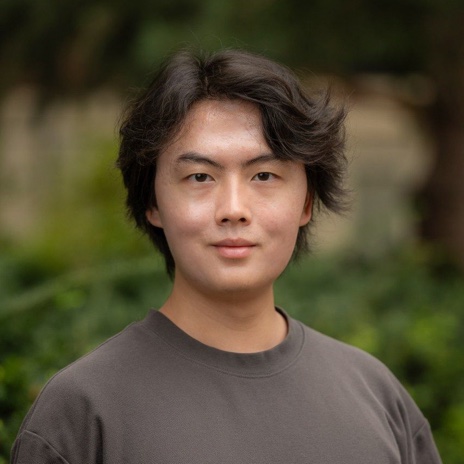
Mingxuan Liu 刘明轩
Third-year PhD candidate in Astronomy at the University of Michigan
What accelerates cosmic rays and shapes their paths?
Cosmic rays are nonthermal particles with far more energy than most particles in the gas around them. For my thesis with Mateusz Ruszkowski, I simulate how particles gain energy in magnetized turbulence and how magnetic fluctuations scatter them as they travel away from their sources. I’m also interested in using physics-informed machine learning to infer how quickly cosmic rays diffuse through interstellar gas.
Drag the divider or use the arrow keys to compare.
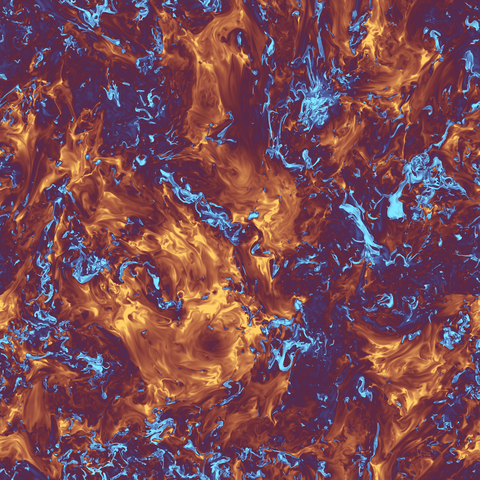
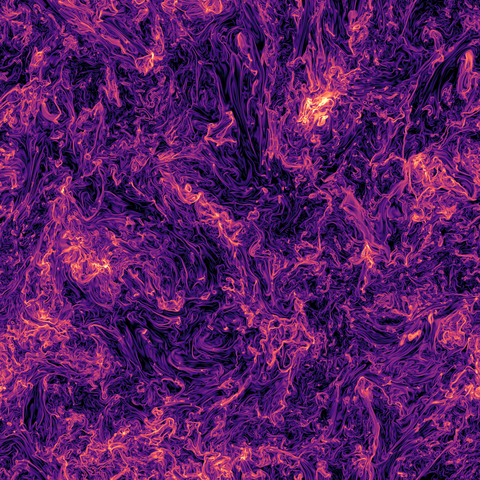
Both maps show the same slice of simulated intracluster gas, the gas between galaxies in a cluster. On the left, bright strands trace a high local Ohmic heating rate. On the right, plasma β gives the ratio of thermal to magnetic pressure. Magnetic pressure dominates in blue regions and thermal pressure in gold.
How are cluster filaments heated?What I work on
-
Cosmic-ray transport and feedback
I’m starting to measure how often cosmic rays scatter. That rate determines how far they travel and how hard they push on gas.
-
Particle acceleration in shear-driven turbulence
MHD particle-in-cell simulations of a Kelvin–Helmholtz layer, following the particles the turbulence energizes. Published in ApJ 1009, 247 (2026).
-
Heating filaments in multiphase turbulence
In our simulations, Ohmic and viscous dissipation help keep cold filaments near 104 K.
-
Rayleigh–Taylor unstable flames
Two perturbation modes on a model flame front. Which of five growth behaviors you get depends on GCD(k1, k2). Undergraduate work.
A little about me
I earned my B.S. at Emory University in May 2024, with majors in Physics and Astronomy and Quantitative Sciences (Informatics track). At Emory I worked with Elizabeth P. Hicks on Rayleigh–Taylor unstable flames. In my first year I also translated Janna Levin’s Black Hole Survival Guide into Chinese. It was published in 2022 and is rated 8.6 on Douban.
I earned my M.S. in Astronomy at the University of Michigan in May 2026. These days I teach introductory astronomy and share my home in Ann Arbor with a husky named Vanilla.