← All research projects

Published · Physical Review Fluids, 2024

Rayleigh–Taylor unstable flames and the inverse cascade

Why some burning fronts settle into traveling waves while others break into chaotic, growing bubbles.

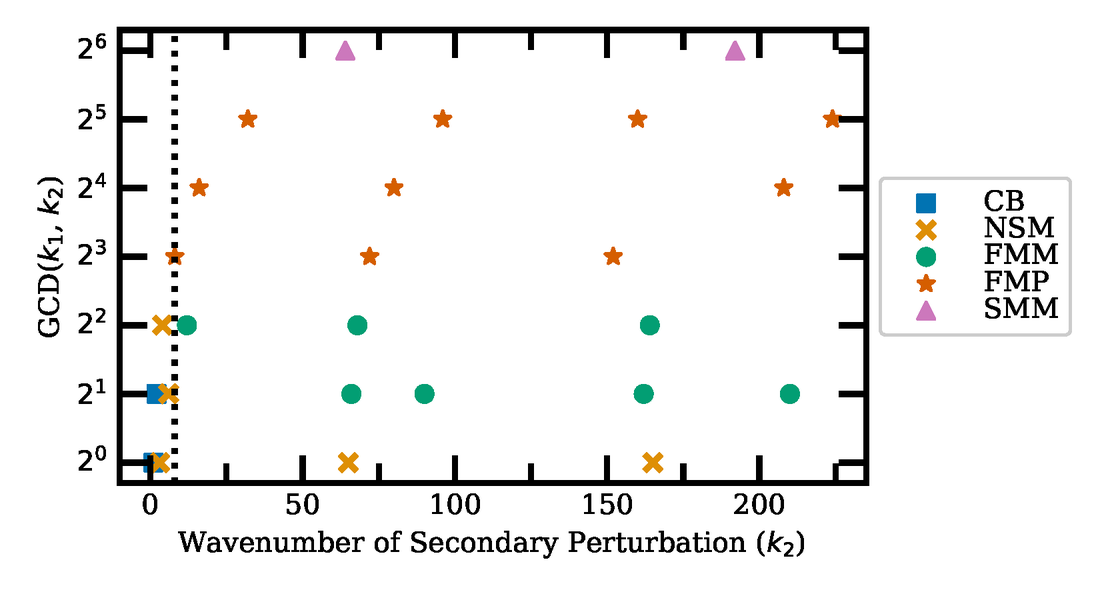
Phase diagram of flame solution types plotted against secondary-mode wavenumber
                      and the greatest common divisor of the two wavenumbers.
The solution-type phase diagram. Which of the five behaviors a flame picks depends on GCD(k1, k2), not on k2 itself.

Put a light fluid underneath a heavy one and the interface between them goes unstable: bubbles rise, spikes fall, and small wrinkles merge into larger ones. That merging, an inverse cascade in wavenumber, is what makes the classical Rayleigh–Taylor mixing layer forget its initial conditions and settle into self-similar growth. We wanted to know whether a burning interface forgets in the same way.

It does not, or at least not straightforwardly. A reacting front can stabilize itself: perturb a model flame with a single mode and it stops growing, locking into a steady traveling wave that can persist almost indefinitely. We perturbed it with two instead, a large-amplitude primary mode k1 and a smaller secondary mode k2, and looked at what it takes to break that stalemate.

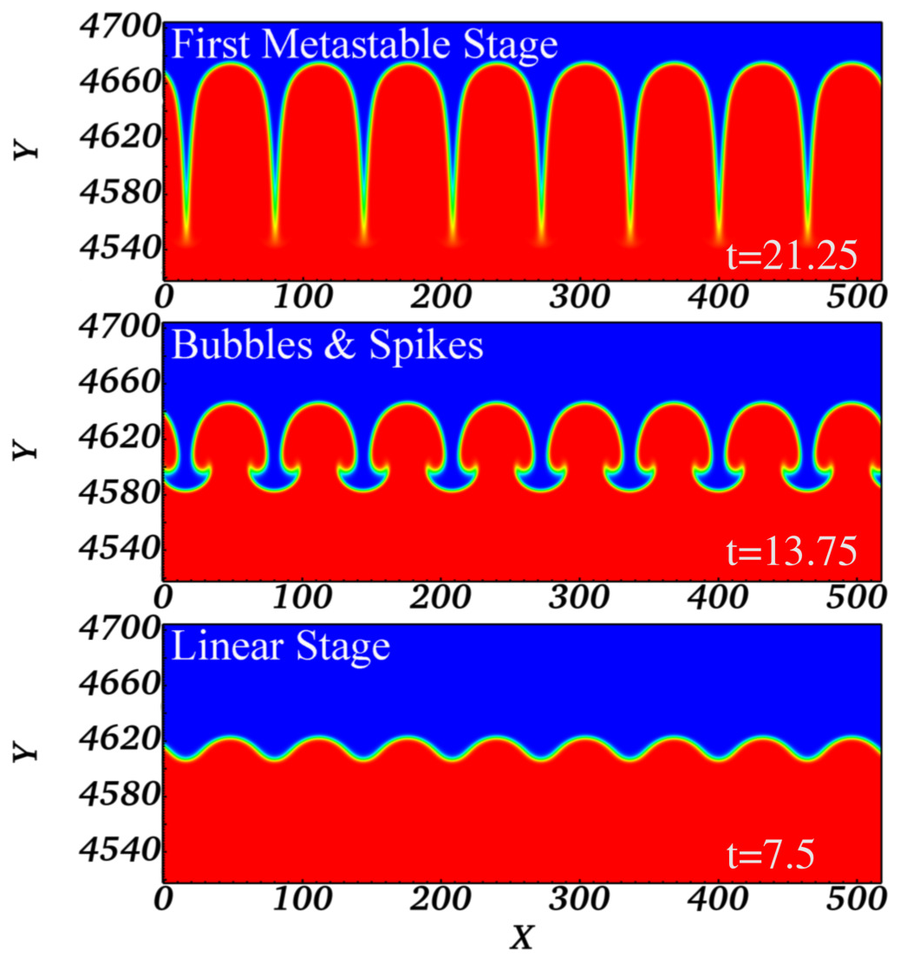
Early on the two modes ignore each other and the flame propagates as a metastable traveling wave. Once the secondary mode has grown large enough they couple, the traveling wave is destabilized, and the bubbles take off. What the coupling produces is a long-wavelength mode whose wavenumber is the greatest common divisor of the two you started with.
We found five distinct flame-growth solution types, selected by GCD(k1, k2). Depending on that one number the flame may stall, develop coherent pulsations, settle back into a metastable traveling wave, or run away into chaotic burning. The same two-mode dynamics show up in ablative and classical Rayleigh–Taylor, which suggests all three share a mode-coupling mechanism.

Direct numerical simulations of a 2D Boussinesq premixed model flame with Nek5000, a spectral-element CFD code: 512 × 2304 elements at spectral order N = 9.

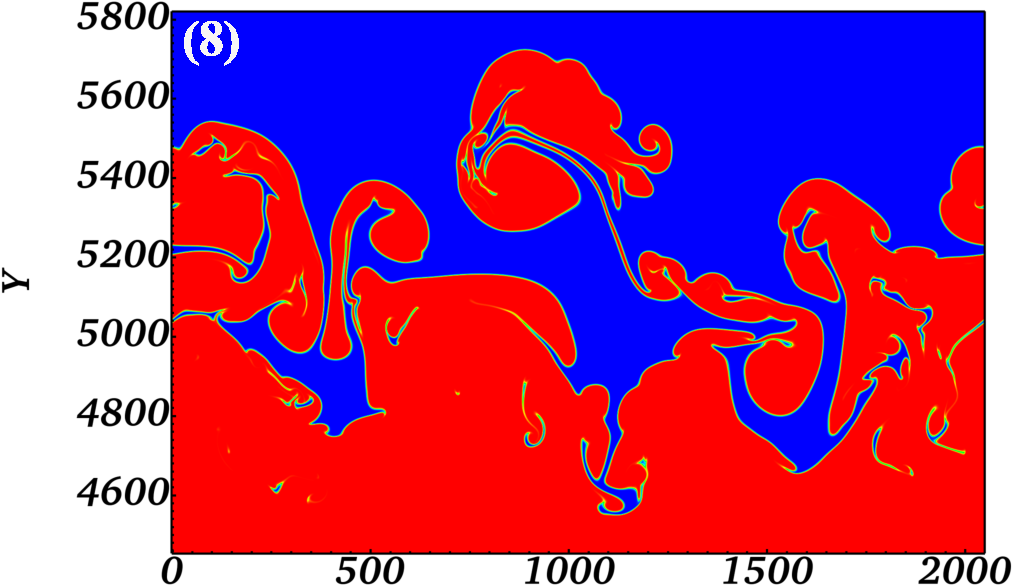
Simulation snapshot of a Rayleigh-Taylor unstable flame front, with burnt fluid
                    in red rising into unburnt fluid in blue as large mushroom-shaped bubbles.
A Rayleigh–Taylor unstable flame deep in the chaotic burning regime. Burnt fluid (red) rises into unburnt fluid (blue) as bubbles that merge and grow without bound.
Three stacked snapshots showing a flame front growing from a small sinusoidal
                    perturbation into bubbles and spikes, then stabilising.
The early stage: a small perturbation grows exponentially, bubbles and spikes form, and the flame settles into the metastable traveling wave that two-mode coupling later breaks.