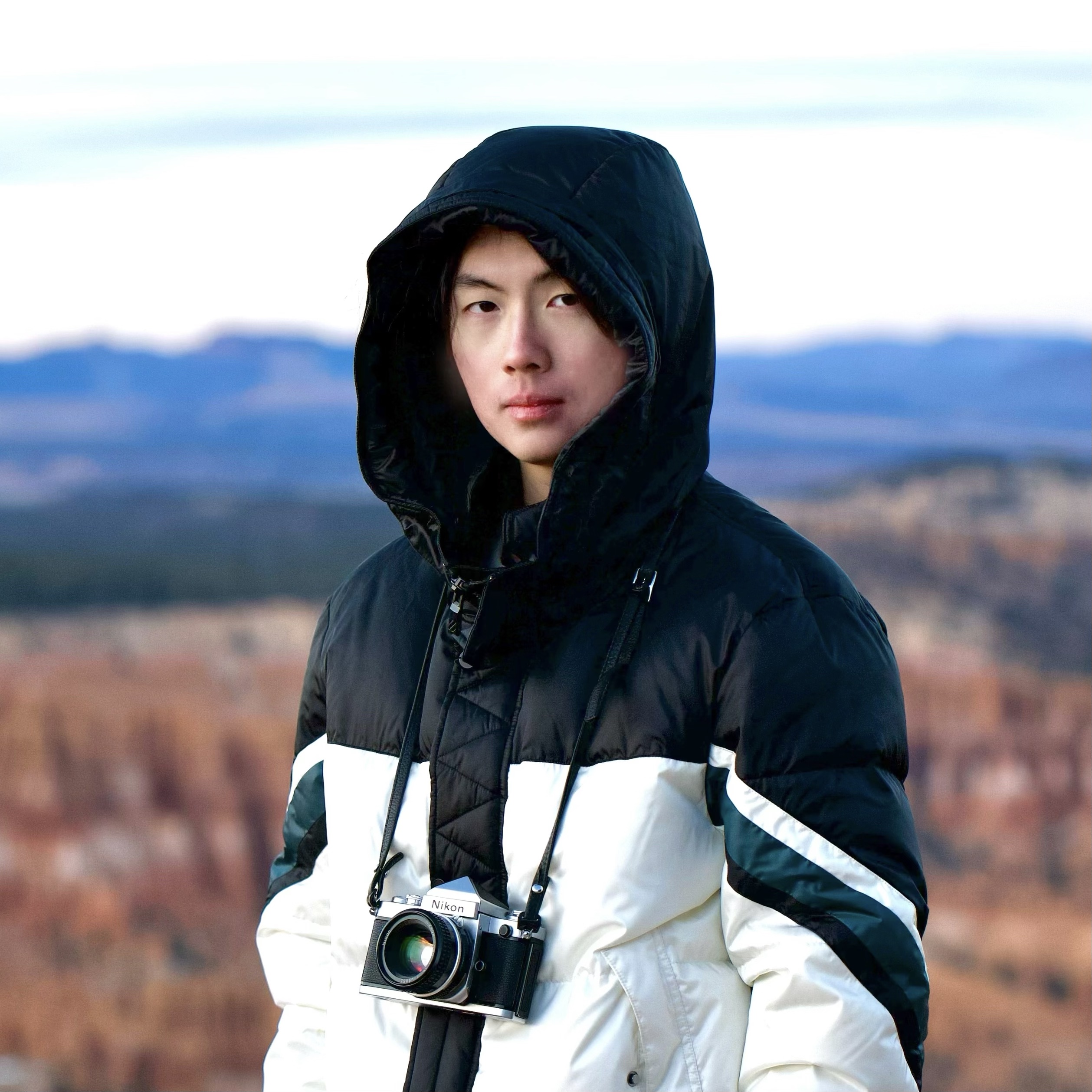
Mingxuan Liu 刘明轩
PhD Candidate · Department of Astronomy · University of Michigan
I am a third-year PhD candidate in the Department of Astronomy at the University of Michigan, working with Mateusz Ruszkowski. I work on plasma astrophysics: how turbulence, magnetic fields and cosmic rays move energy around in galaxies and galaxy clusters, and what that does to the gas.
Almost all of it is simulation. One strand is particle acceleration in turbulence driven by sheared flow, which came out in ApJ this year. A second, still in progress, is turbulence in multiphase gas; I will say more about that once it is written up. The third is cosmic-ray transport, which I am starting now: measuring the scattering rate that sets how strongly cosmic rays couple to gas, rather than assuming it the way feedback models currently have to.
Before Michigan I was an undergraduate at Emory University, working with Elizabeth P. Hicks on Rayleigh–Taylor unstable flames. As a first-year there I also translated Janna Levin’s Black Hole Survival Guide into Chinese; it was published in 2022 and is rated 8.6 on Douban. I teach introductory astronomy at Michigan, and I have a husky named Vanilla.
Plasma astrophysics, magnetohydrodynamics, cosmic-ray acceleration and transport, turbulence, multiphase gas, hydrodynamic instabilities, numerical methods and HPC.
News
What I work on
These all come back to the same thing: how ordered flow in a fluid or plasma breaks down, and where the energy ends up.
-
Cosmic-ray transport and feedback
Measuring the scattering rate that sets how far cosmic rays travel and how hard they push on gas, instead of putting it in by hand.
-
Turbulence in multiphase gas
What happens to turbulent energy in a medium where hot and cold gas sit side by side. In progress.
-
Particle acceleration in shear-driven turbulence
MHD particle-in-cell simulations of a Kelvin–Helmholtz layer, following the particles the turbulence energizes. Accepted by ApJ, 2026.
-
Rayleigh–Taylor unstable flames
Two perturbation modes on a model flame front. Which of five growth behaviors you get depends on GCD(k1, k2). Undergraduate work.